
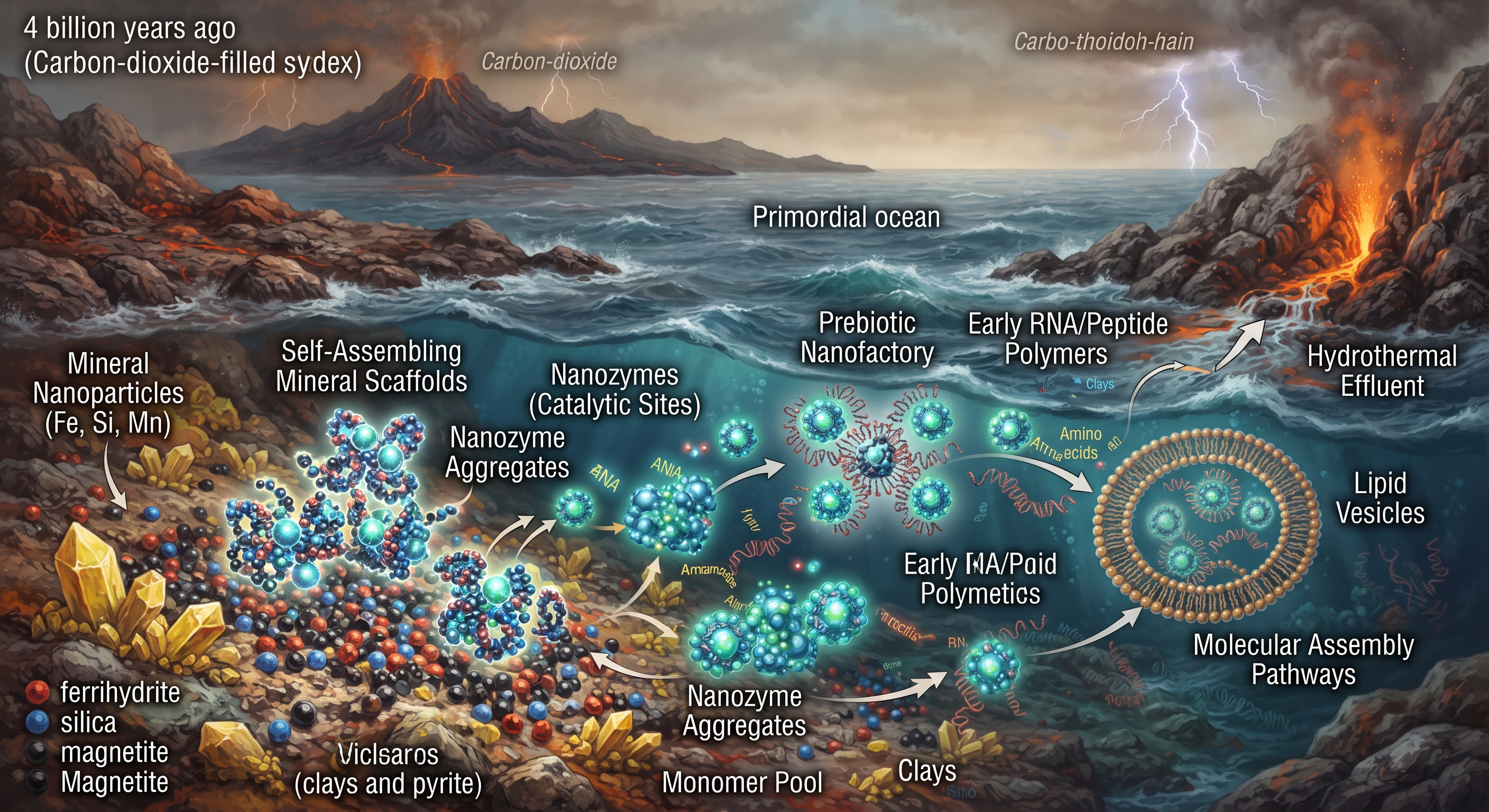
For decades, we’ve been taught the classic “primordial soup” theory—the idea that a chaotic mixture of chemicals, energized by lightning or volcanic heat, accidentally formed the first building blocks of life.
But a compelling new theory is gaining traction in the scientific community: The Nanozyme Hypothesis. It suggests that life wasn’t just a lucky accident; it was a result of specialized, microscopic “factories” operating on the early Earth.
What are Nanozymes?
At the heart of this theory are mineral nanoparticles. In the natural world, these are tiny clusters of minerals that possess catalytic properties—meaning they can speed up chemical reactions.
Scientists refer to them as “nanozymes” because they function similarly to biological enzymes (the proteins in your body that handle everything from digestion to DNA replication), but they are made of inorganic material, such as iron, sulfur, or gold-based minerals.
The “Factory” Mechanism
If the early Earth was a hostile environment—full of UV radiation and volatile chemicals—how did life survive long enough to replicate? The Nanozyme Hypothesis suggests these mineral particles acted as both a shield and a workbench:
- Protection: Mineral surfaces provided a safe harbor for fragile organic molecules to group together, shielding them from the harsh, radiation-heavy environment of the Hadean Eon.
- Concentration: By “trapping” simple gases and chemicals on their surfaces, these particles increased the local concentration of ingredients, making complex reactions far more likely to occur.
- Catalysis: Acting as tiny machines, these minerals lowered the energy barrier for chemical reactions, effectively “building” the building blocks of life—amino acids and nucleotides—much faster than random chance would allow.
Why Gold Matters
Recent research has focused heavily on gold-based nanoparticles. Some models suggest that when gold particles are protected by organic molecules, they become highly stable catalysts. These “gold-factory” environments could have been the secret engine driving the world’s very first metabolism, setting the stage for the transition from chemistry to biology.
Why This Changes the Search for Alien Life
This discovery shifts how astrobiologists look for life on other planets. Instead of just looking for organic molecules, we should be looking for specific geological environments—regions rich in mineral diversity where these “nano-factories” could have flourished.
If life is a natural byproduct of mineral chemistry, then the universe might be far more “alive” than we ever dared to hope.

Leave a Reply