
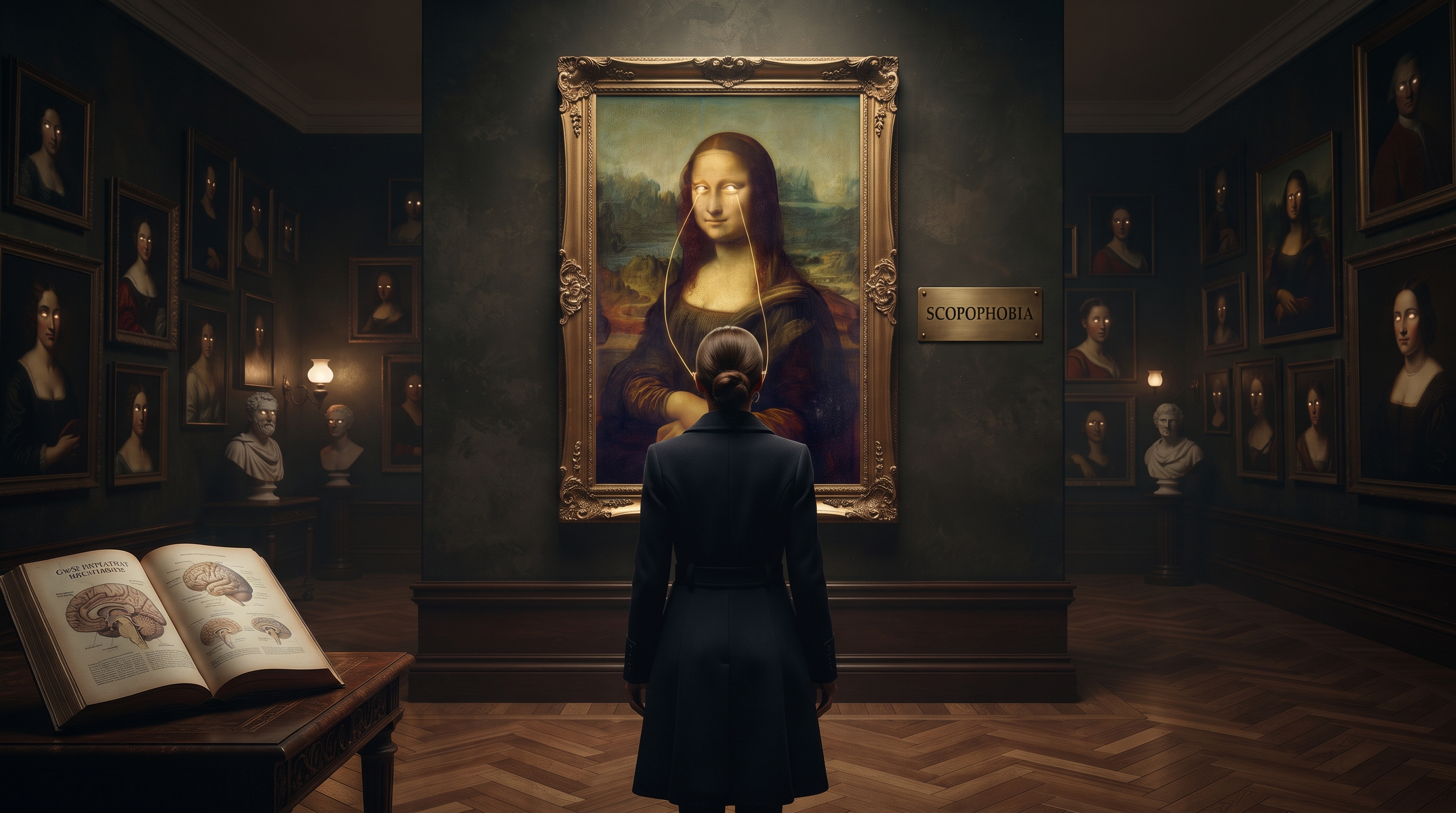
Have you ever felt that unmistakable prickle on the back of your neck? That sudden, primal certainty that someone is staring right at you—only to turn around and find nobody there, even as your pulse races?
That ancient, haunting reaction is closely tied to scopophobia, the intense, clinical fear of being looked at. But why does a simple gaze evoke such a powerful physical response? To understand the roots of this terror, we have to look inside the human brain, examine ancient evolutionary survival tactics, and explore classic optical illusions like the Mona Lisa effect.
1. The Mona Lisa Effect: Prioritizing Safety Over Accuracy
To understand why our brains panic at a stare, we can look at phenomena like the Mona Lisa effect—the famous optical illusion where painted eyes seem to track you across a room.
While psychologists and neuroscientists have proven that her eyes actually look slightly to your right, your brain stubbornly refuses to believe it. Why? Because human evolution deliberately prioritized safety over accuracy. In an ancestral environment, assuming a potential predator was looking at you—even if they weren’t—carried zero cost. Conversely, assuming a predator wasn’t looking at you when they actually were meant certain death. Your brain is hardwired to err on the side of caution.
2. The Neuroscience of the Gaze and the Amygdala
Millions of years ago, a pair of eyes locking onto you in the wild rarely meant a friendly greeting. More often than not, it meant a predator was hunting or a rival was preparing for an attack.
To keep our ancestors alive, evolution built a hypersensitive alarm system centered right inside the amygdala—the brain’s emotional and threat-processing command center. When someone stares at us, the amygdala triggers a rapid surge of adrenaline and cortisol before your logical, conscious mind even has time to catch up. Your body physically prepares for “fight or flight” just from the weight of a glance.
3. When the Safety Mechanism Malfunctions: Scopophobia
For most people, that sudden prickle of discomfort passes quickly once they realize they are safe. However, for individuals living with scopophobia, this evolutionary safety mechanism malfunctions entirely.
For someone struggling with scopophobia, a simple glance isn’t just uncomfortable—it is paralyzingly terrifying. Walking down a crowded hallway, stepping into public, or even standing in a museum room full of artwork and portraits can trigger full-blown panic attacks. Their brain treats an ordinary look as an immediate, life-or-death threat, locking their nervous system into a state of chronic high alert.
Conclusion: The Eyes That Follow Us
Art captures our attention by holding up a mirror to human perception, but it can accidentally trip our deepest, most ancient evolutionary wires. Gaze detection is one of our oldest survival traits, keeping our ancestors safe in the wilderness, but in modern society, it can sometimes turn our own minds against us.
Could you stand in a quiet, portrait-filled gallery alone tonight?
Watch the full video on YouTube:
References & Web Resources
- Boyarskaya, E., Sebastian, A., Bauermann, T., Hecht, H., & Tüscher, O. (2014). The Mona Lisa effect: Neural correlates of centered and off‐centered gaze. Human Brain Mapping, 36(2), 619–632. https://doi.org/10.1002/hbm.22651
- Elevator World. (2023, October 13). The 13th Floor. Retrieved from https://elevatorworld.com/blog/the-13th-floor/
- Horstmann, G., & Loth, S. (2019). The Mona Lisa illusion—Scientists see her looking at them though she isn’t. i-Perception, 10(1), 1–13. https://doi.org/10.1177/2041669518821702
- Reader’s Digest. (2025, June 12). Here’s Why Skyscrapers Don’t Have 13th Floors. Retrieved from https://www.rd.com/article/why-skyscrapers-dont-have-13th-floors/
- ThomasNet. (2023, September 29). So Feared that Hotels Skip an Entire Floor — Why Does the Number 13 Get Such a Bad Rap? Retrieved from https://www.thomasnet.com/insights/so-feared-that-hotels-skip-an-entry-floor-why-does-the-number-13-get-such-a-bad-rap-thoughts-after-dark/
- Wardenaar, K. J., Lim, C. C. W., Al-Hamzawi, A. O., Alonso J., Andrade, L. H., Benjet, C., … & de Jonge, P. (2017). The cross-national epidemiology of specific phobia in the World Mental Health Surveys. Psychological Medicine, 47(10), 1744–1760. https://doi.org/10.1017/S0033291717000171X
- Wikipedia. (n.d.). Triskaidekaphobia. Retrieved September 16, 2026, from https://en.wikipedia.org/wiki/Triskaidekaphobia

Leave a Reply