
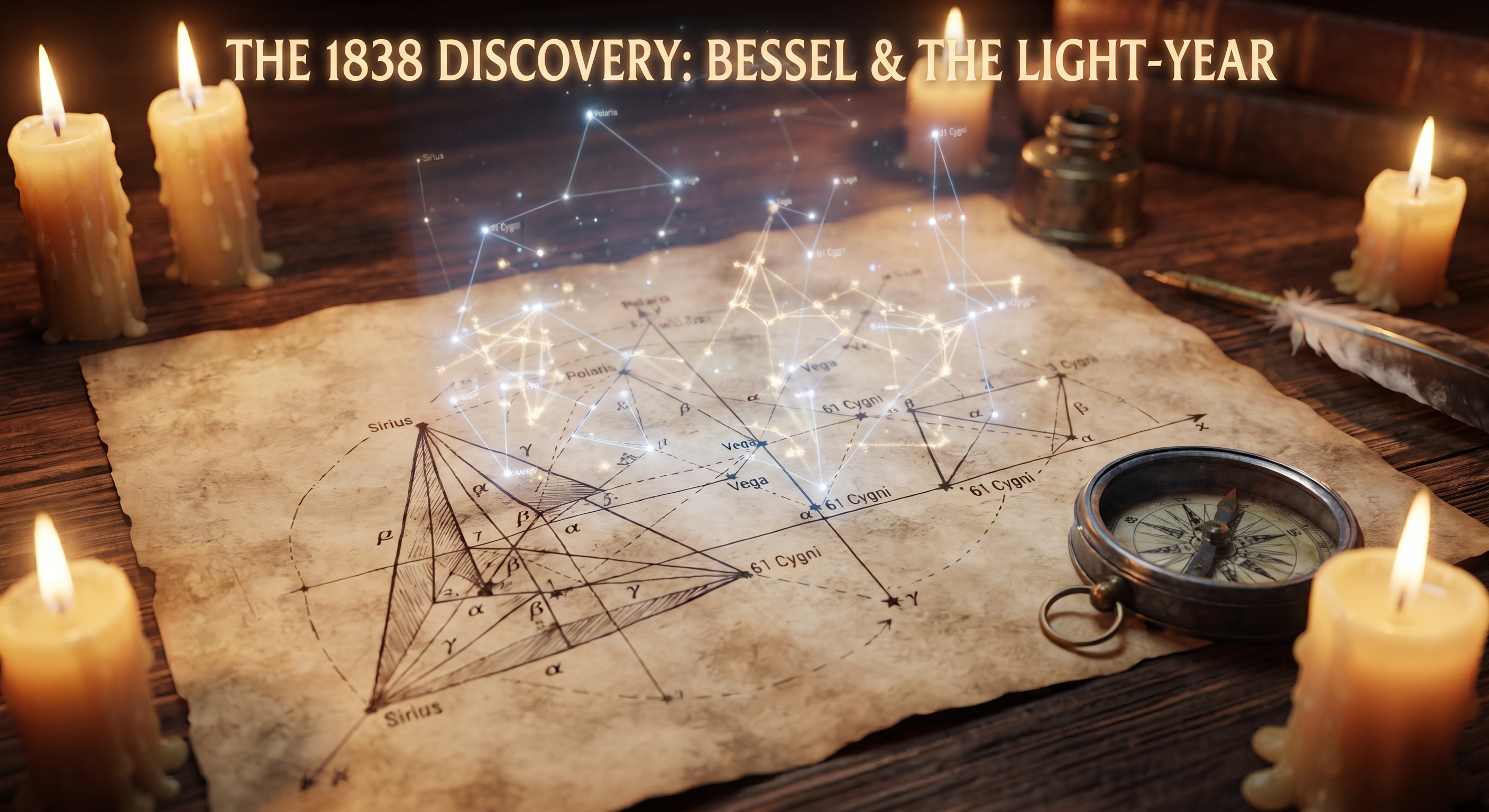
When we gaze up at the night sky, we aren’t just seeing the cosmos as it is right now—we are looking straight into the past. But how did humanity transition from guessing the positions of distant stars to realizing that space is so unimaginably vast that we have to measure it using time?
The answer lies in a brilliant 19th-century scientific breakthrough that laid the groundwork for the light-year.
1. Friedrich Bessel’s Target: 61 Cygni (1838)
The foundation of this cosmic measurement was established in 1838 by German astronomer and mathematician Friedrich Bessel. Bessel set out to solve a problem that had stumped scientists for centuries: measuring the exact distance to a star.
Instead of picking a random point of light, Bessel chose 61 Cygni, a faint binary star system known for its exceptionally high proper motion (it moved rapidly across the night sky relative to other stars). Bessel reasoned correctly that a star moving that quickly across our line of sight was likely much closer to Earth than slower, dimmer background stars.
2. The Geometry of Space: Stellar Parallax
To measure a distance so immense without ever leaving Earth, Bessel utilized basic geometry and Earth’s orbit around the Sun.
- The Baseline: He used Earth’s orbital diameter as a baseline, spanning a staggering 186 million miles.
- The Observation: Using a high-precision heliometer at the Königsberg Observatory, Bessel tracked how much 61 Cygni seemed to shift against distant background stars over a six-month interval.
- The Parallax Effect: By measuring this subtle angular wobble—known as stellar parallax—he secured the crucial angle needed for calculation.
3. Crunching the Numbers and Coining the Term
The angle Bessel measured was astonishingly small—about 0.314 arcseconds. Using advanced trigonometry, he calculated that 61 Cygni was roughly 10.3 light-years away (about 60 trillion miles).
Because expressing such immense distances purely in miles created unwieldy numbers, the concept evolved into using travel time through space. While Bessel established the mathematical foundation, the term itself was popularized shortly after in German scientific and popular literature, notably appearing with writer Otto Ule coining the term Lichtjahr.
Watch the Video
To see a visual breakdown of how stellar parallax works and explore more about the history of the light-year, watch the full video on YouTube:
Web Bibliography & Sources
- Freestarcharts: 61 Cygni – Measuring the distance to the stars – Overview of Friedrich Bessel’s 1838 breakthrough calculation. Available at: Freestarcharts.
- Max Planck Institute for Radio Astronomy: The Distances of the Stars – Notes on Bessel winning the race to measure stellar distance via trigonometric parallax in 1838. Available at: MPIfR Press Release.
- Wikipedia: Light-year – Historical notes on Friedrich Bessel and Otto Ule coining the term in 1851. Available at: Wikipedia Entry.

Leave a Reply