
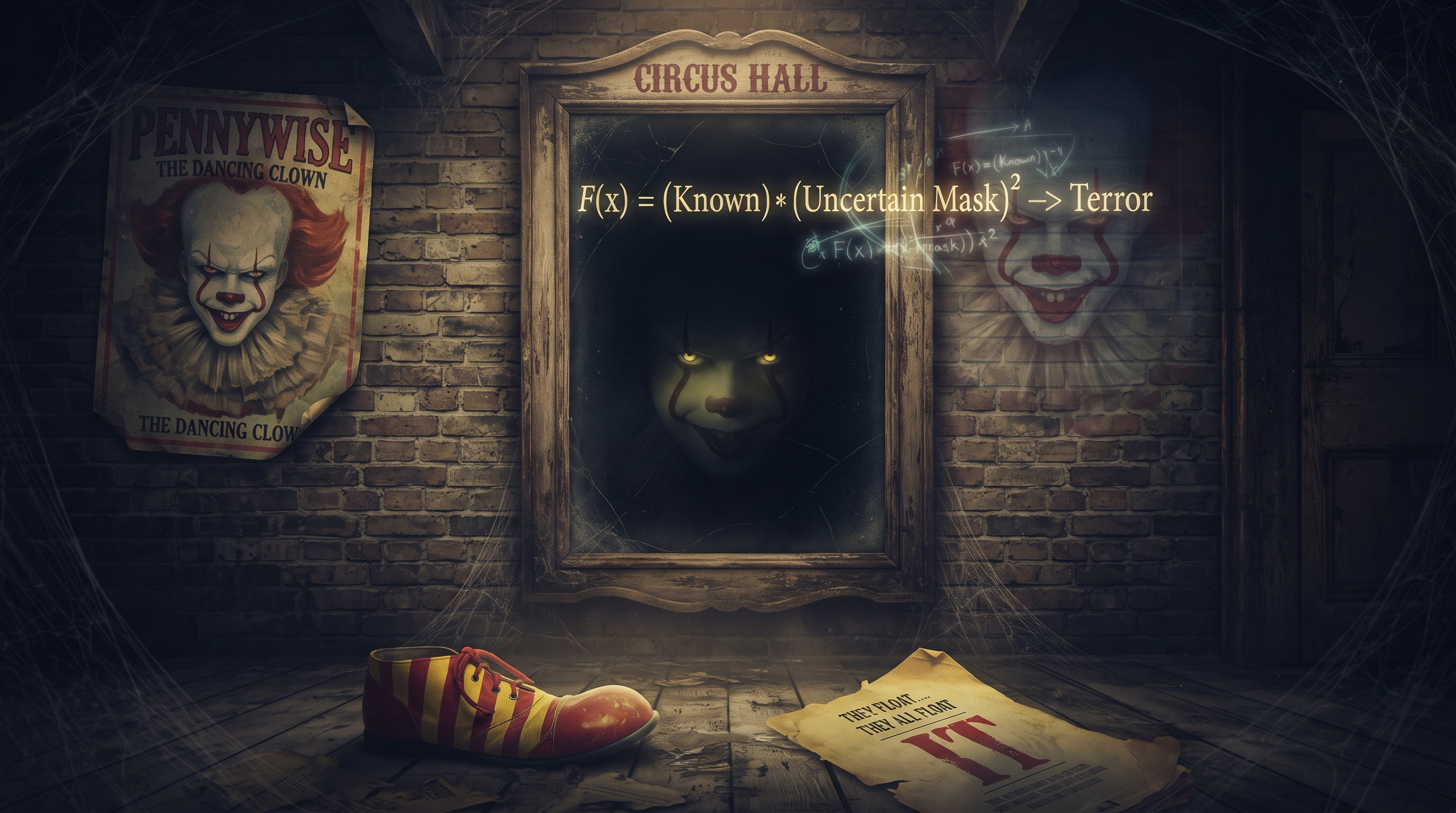
What do an irrational fear of painted faces, ancient human evolutionary psychology, and Stephen King’s terrifying masterpiece IT all have in common? Today, we are peeling back the layers of greasepaint to break down the complex psychology and dark mystery behind our collective dread.
The Evolutionary Glitch of Coulrophobia
Psychologists study coulrophobia—the intense fear of clowns—through the lens of predictability and facial recognition. Human beings naturally rely on subtle micro-expressions to calculate intent, emotional state, and safety.
Because traditional clown makeup creates a permanent, highly exaggerated mask, your brain’s predictive processing hits a sudden glitch. When expression equals zero variance, your evolutionary risk calculation defaults straight to danger. The brain desperately scans for a genuine smile or a furrowed brow, but finds only static, unmoving paint. This biological mismatch triggers an immediate survival alarm: because you cannot read the threat, your instincts assume the threat is everywhere.
Weaponizing the Uncanny Valley
For generations, society treated clowns as a constant—a fixed variable of harmless childhood joy. But in 1986, Stephen King inverted that equation forever with his novel IT.
He weaponized the uncanny valley, transforming a familiar cultural symbol into an ancient, shape-shifting cosmic predator. Pennywise the Dancing Clown tracks and multiplies human fear on a calculated, recurring cycle, feeding on the very terror it generates and turning the bright logic of the circus into a dark hunting ground.
Pennywise proved a chilling psychological rule: when a familiar variable changes its sign from positive to negative, the resulting impact is exponential. He didn’t just create a monster; he redefined the mathematics of our nightmares by making the friendly face a lethal weapon.
The math of fear is simple: take the known, add a mask of uncertainty, and watch the terror multiply.
Watch the full video on YouTube:
References & Web Resources
- Frontiers in Psychology. (2021, March 24). The Dark Side of the Circus: Exploring the Etiology of Coulrophobia. Retrieved from https://www.frontiersin.org/articles/10.3389/fpsyg.2021.637877/full (A peer-reviewed psychological study investigating why human brains struggle with processing exaggerated facial makeup, linking it to uncertainty and evolutionary risk assessment.)
- Harvard Gazette. (2019, October 30). The Uncanny Valley and Why Clowns Freak Us Out. Retrieved from https://news.harvard.edu/gazette/story/2019/10/the-science-behind-why-people-fear-clowns/ (Examines how the lack of micro-expressions in masked faces triggers a biological survival alarm and unease in the human brain.)
- The Atlantic. (2022, September 08). How Stephen King Weaponized the Clown. Retrieved from https://www.theatlantic.com/entertainment/archive/2022/09/stephen-king-it-pennywise-clown-fear/671342/ (A cultural analysis of how the 1986 publication of Stephen King’s masterpiece permanently transformed the perception of clowns in Western society.)
- Psychology Today. (2024, January 11). Coulrophobia: Understanding the Intense Fear of Clowns. Retrieved from https://www.psychologytoday.com/us/basics/coulrophobia (A comprehensive guide breaking down the clinical definitions, triggers, and cognitive mechanisms behind fear of painted faces.)

Leave a Reply