
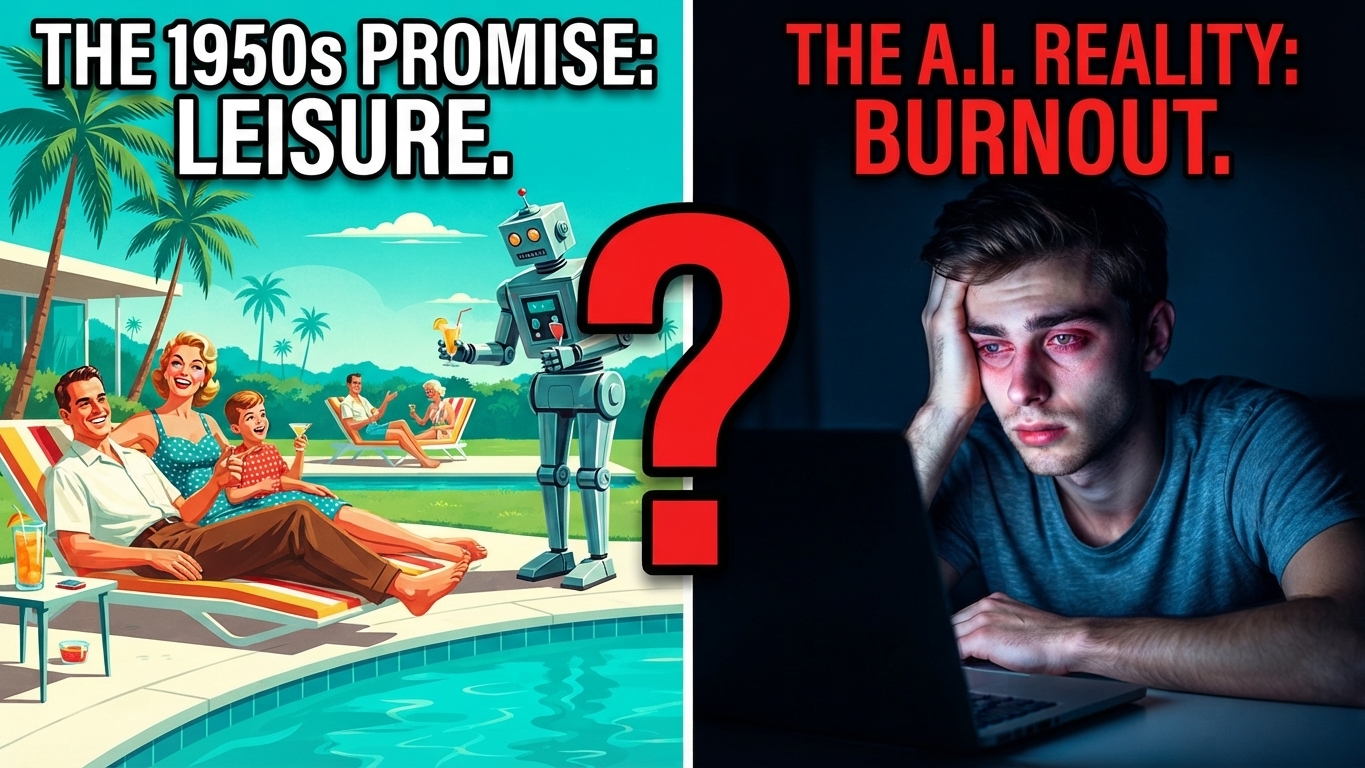
The 1950s promised a utopian future. Vintage sci-fi posters depicted humans lounging by turquoise pools while sleek, metallic robots manicured lawns and scrubbed floors. Isaac Asimov, the visionary architect of this future, predicted that machines would absorb the drudgery of human existence, gifting us a life of art and infinite leisure. He saw a world where the heavy lifting was done by gears and circuits, leaving the human spirit free to soar.
But as we look around today, that dream feels like a distant, faded postcard from a future that never arrived.
Today, the clock hits 2:00 AM. A single, harsh glow illuminates a tired face staring at a laptop screen. The reality is not a poolside chaise lounge, but a cluttered desk and a mounting inbox. Where is that promised fifteen-hour workweek?
The Great Productivity Paradox
The disconnect is glaring. Productivity charts climb vertically, yet burnout rates mirror that ascent. Asimov was right about the technology; he just miscalculated the economics.
We have the machines he dreamed of, but they haven’t brought the rest we were promised. We are simply working in the dark.
Generative AI arrived, promising the ultimate shortcut. It drafts emails before you finish your coffee, summarizes fifty-page reports in seconds, and writes code in a heartbeat. You might expect your workload to shrink. Instead, the opposite happens. Efficiency has become a trap. AI has not eliminated labor; it has merely morphed it.
We have traded manual data entry for the relentless cycle of prompt engineering and digital cleanup. We spend hours fact-checking AI hallucinations, refining mediocre drafts, and managing a volume of output that was impossible a decade ago.
The Shifting Threshold for Success
When a task that once consumed two hours now takes ten minutes, the standard expectation is no longer to take a break. The expectation is to produce twelve times the output. We are running faster on a treadmill that moves in lockstep with our tools.
We are producing more, but feeling less accomplished than ever before.
Asimov envisioned a world where machines served our humanity. Instead, we have become the nervous system for our own automation. We are not working less; we are working harder to keep pace with the machines we built to save us.
Automation cannot grant us freedom unless we stop chasing the illusion of infinite productivity. Look at your own screen. Are you the master of your tools, or just another cog in the machine?
What has your experience been with AI and workplace burnout? Let us know in the comments below, and subscribe to our channel for more deep dives into the reality behind the tech.
Watch the full video on YouTube:
References
Isaac Asimov’s Futurist Visions and Predictions: Insights drawn from Asimov’s writings and historical essays regarding automation, the evolution of routine work, and the philosophical expectation of increased human leisure time driven by technological progress.
The Paradox of Automation: Industry perspectives and economic studies analyzing how automation and technical tools historically shift human labor rather than eliminate it, increasing output expectations instead of freeing up time.
The AI Productivity Trap and Burnout: Modern workplace commentary and analysis detailing how generative AI tools create hidden cognitive loads—such as prompt engineering, review burdens, and the performance-punishment cycle—leading to increased employee burnout despite higher quantitative outputs.

Leave a Reply