
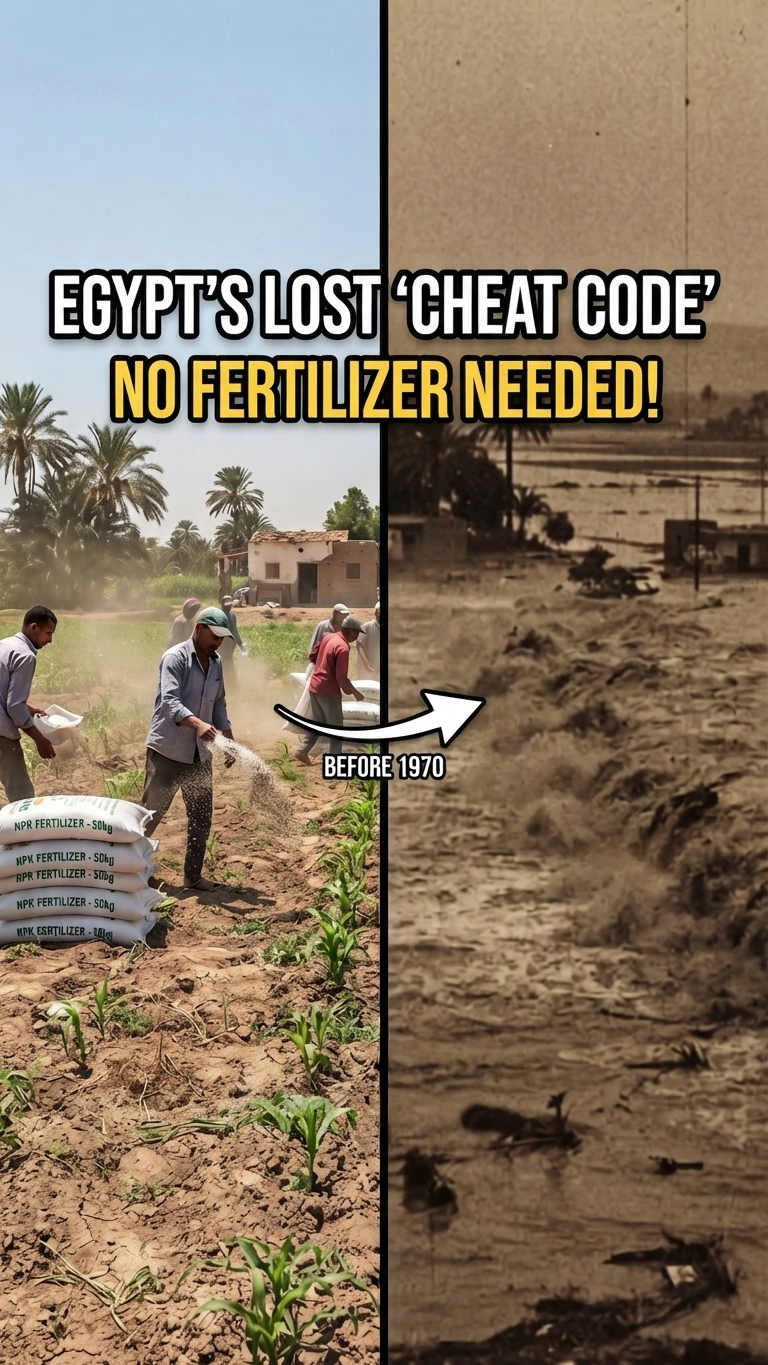
Before the construction of the Aswan High Dam in 1970, Egyptian agriculture operated on a self-sustaining cycle that required zero synthetic fertilizers. Every single summer, heavy monsoon rains pounded the Ethiopian highlands, scouring volcanic rock faces and sending billions of gallons of water rushing two thousand miles north.
This annual summer flood was far more than destructive water. It carried millions of tons of rich, dark volcanic mineral silt. When the floodwaters spread across the Egyptian floodplains, they blanketed the earth in a thick layer of natural fertilizer, completely resetting the soil chemistry from scratch every year. This natural process prevented crop rotation exhaustion and chemical depletion, fueling infinite, self-sustaining harvests for thousands of years.
When the Aswan High Dam locked the river in 1970, it successfully stopped destructive floods, protected cities, and generated vital hydroelectric power. However, it permanently altered the ecosystem by trapping the nutrient-dense silt behind a massive wall. Today, Egyptian agriculture relies heavily on expensive chemical fertilizers to make up for the natural mineral reset that was lost.
References
- Britannica. (n.d.). Aswan High Dam | Description, History, Capacity, Problems, & Facts. Encyclopædia Britannica. Retrieved from https://www.britannica.com/topic/Aswan-High-Dam
- EBSCO Research Starters. (n.d.). Aswan High Dam. Science Research Starters. Retrieved from https://www.ebsco.com/research-starters/science/aswan-high-dam
- National Geographic / Our Shared World (NWNL). (2017). Aswan High Dam Leaves an Environmental Legacy. Retrieved from https://nwnl.wordpress.com/2017/11/07/aswan-high-dam-leaves-an-environmental-legacy/
- TIME Magazine. (1975). Environment: Aswan’s Impact. TIME Archive. Retrieved from https://time.com/archive/6846774/environment-aswans-impact/
- Wikipedia contributors. (n.d.). Flooding of the Nile. Wikipedia, The Free Encyclopedia. Retrieved from https://en.wikipedia.org/wiki/Flooding_of_the_Nile

Leave a Reply