
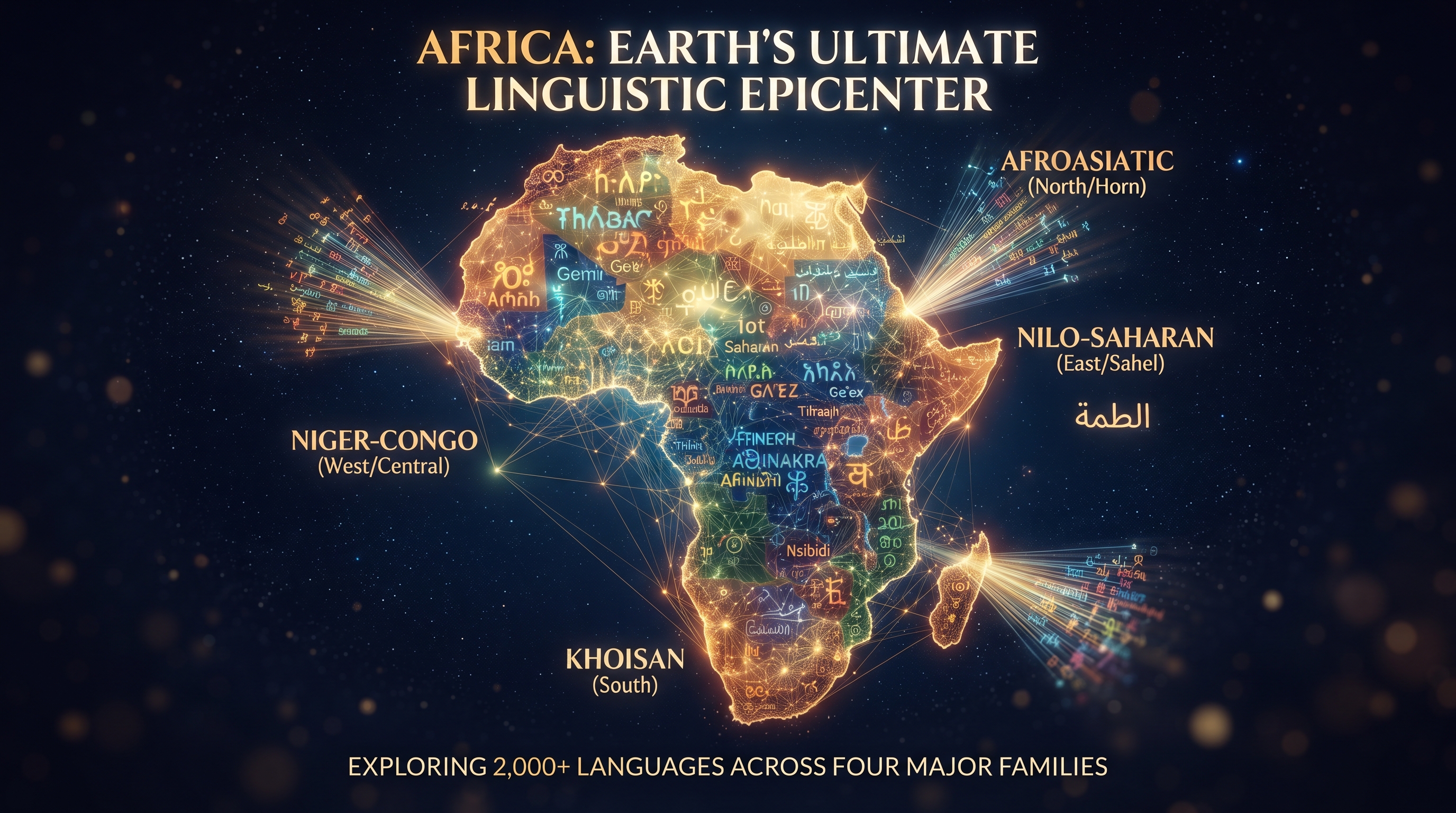
When we think about global biodiversity hotspots, regions like the Amazon rainforest or the coral reefs of Southeast Asia instantly come to mind. But when it comes to linguistic diversity, no place on Earth matches the vibrant, complex tapestry found across the African continent.
Home to over 2,000 distinct spoken languages—representing nearly a third of all languages spoken worldwide—this region is a true global linguistic epicenter. Yet, beneath this staggering variety lies a structured, fascinating tree of heritage. Almost all of these thousands of tongues trace their origins back to just four major language families.
Let us dive deep into these four pillars and answer the ultimate question: Which family boasts the highest number of speakers?
The Four Pillars: Africa’s Major Language Families
To understand the continent’s linguistic layout, linguists group these thousands of tongues into four distinct geographical and historical families, first famously classified by scholar Joseph Greenberg:
1. Niger-Congo
- Overview: By far the largest family in terms of geographic spread and sheer number of individual languages, the Niger-Congo family spans West, Central, East, and Southern Africa. It includes hundreds of related languages and is most famous for housing the Bantu branch, which covers a vast swath of sub-Saharan Africa.
- Key Characteristics: Niger-Congo languages are widely known for their complex noun-class systems (often referred to by non-linguists as “grammatical gender” or noun prefixes) and rich tonal structures.
- Notable Examples: Swahili (the most widely spoken indigenous language in Africa), Yoruba, Igbo, Zulu, Shona, and Lingala.
2. Afroasiatic
- Overview: Stretching across North Africa, the Horn of Africa, and parts of the Sahel and the Middle East, the Afroasiatic family has some of the oldest written and recorded histories in human civilization.
- Key Characteristics: Afroasiatic languages frequently utilize a root-and-pattern system where words are built from consonant roots modified by internal vowels.
- Notable Examples: Arabic (which has tens of millions of speakers on the continent), Amharic, Hausa, Oromo, Somali, and ancient languages like Ancient Egyptian and Coptic.
3. Nilo-Saharan
- Overview: Spanning across the upper parts of the Nile and Sahara river basins—from Chad and Sudan down through Kenya and Tanzania—the Nilo-Saharan family is immensely diverse internally, with many distinct language branches that have puzzled linguists for decades due to their deep historical roots.
- Key Characteristics: These languages often feature intricate verb morphologies and rich systems of grammatical tone.
- Notable Examples: Dinka, Nuer, Kanuri, Luo, and Songhai.
4. Khoisan
- Overview: Concentrated primarily in Southern Africa, particularly among indigenous groups in the Kalahari Desert region (such as the San and Nama), the Khoisan family represents some of the oldest continuous linguistic lineages on Earth.
- Key Characteristics: Khoisan languages are globally famous for their unique click consonants—sounds made with the tongue and mouth air pressure that function as full-fledged letters and consonants in words.
- Notable Examples: Nama, ǃXóõ (noted for having one of the largest inventory of phonemes in the world), and Sandawe.
The Big Question: Which Language Family Has the Highest Number of Speakers?
If you guessed Niger-Congo, you are correct!
While Afroasiatic boasts massive individual heavyweights—most notably Arabic, which is spoken by hundreds of millions of people across North Africa and the Middle East—the Niger-Congo family reigns supreme when looking at the total aggregate number of speakers across the continent.
This dominance is heavily driven by the massive expansion of the Bantu branch over the last few thousand years. Languages like Swahili (with upwards of 100 to 150 million speakers as a first or second language), Yoruba (tens of millions), Igbo, and Zulu contribute to a total population of hundreds of millions of people who speak a Niger-Congo language every single day.
A Tapestry Worth Preserving
From the complex click consonants of the southern deserts to the tonal masterpieces of West Africa and the historic scripts of the north, Africa’s linguistic landscape is a testament to human adaptability, culture, and history.
As globalization and dominant trade languages continue to shift modern communication, documenting and celebrating these 2,000+ languages ensures that human history remains as colorful and diverse as ever.
What is your favorite linguistic fact about African languages? Let us know your thoughts in the comments below!
Bibliography
Harvard University. (n.d.). Introduction to African languages. Faculty of Arts and Sciences. https://alp.fas.harvard.edu/introduction-african-languages
Encyclopædia Britannica. (n.s.). Niger-Congo languages. Encyclopædia Britannica. https://www.britannica.com/topic/Niger-Congo-languages
Wikimedia Foundation. (2026). Languages of Africa. Wikipedia, The Free Encyclopedia. https://en.wikipedia.org/wiki/Languages_of_Africa
Sorosoro Program. (n.d.). Language families in Africa. Sorosoro: For the Preservation of Endangered Languages. https://www.sorosoro.org/en/language-families-in-africa/

Leave a Reply