
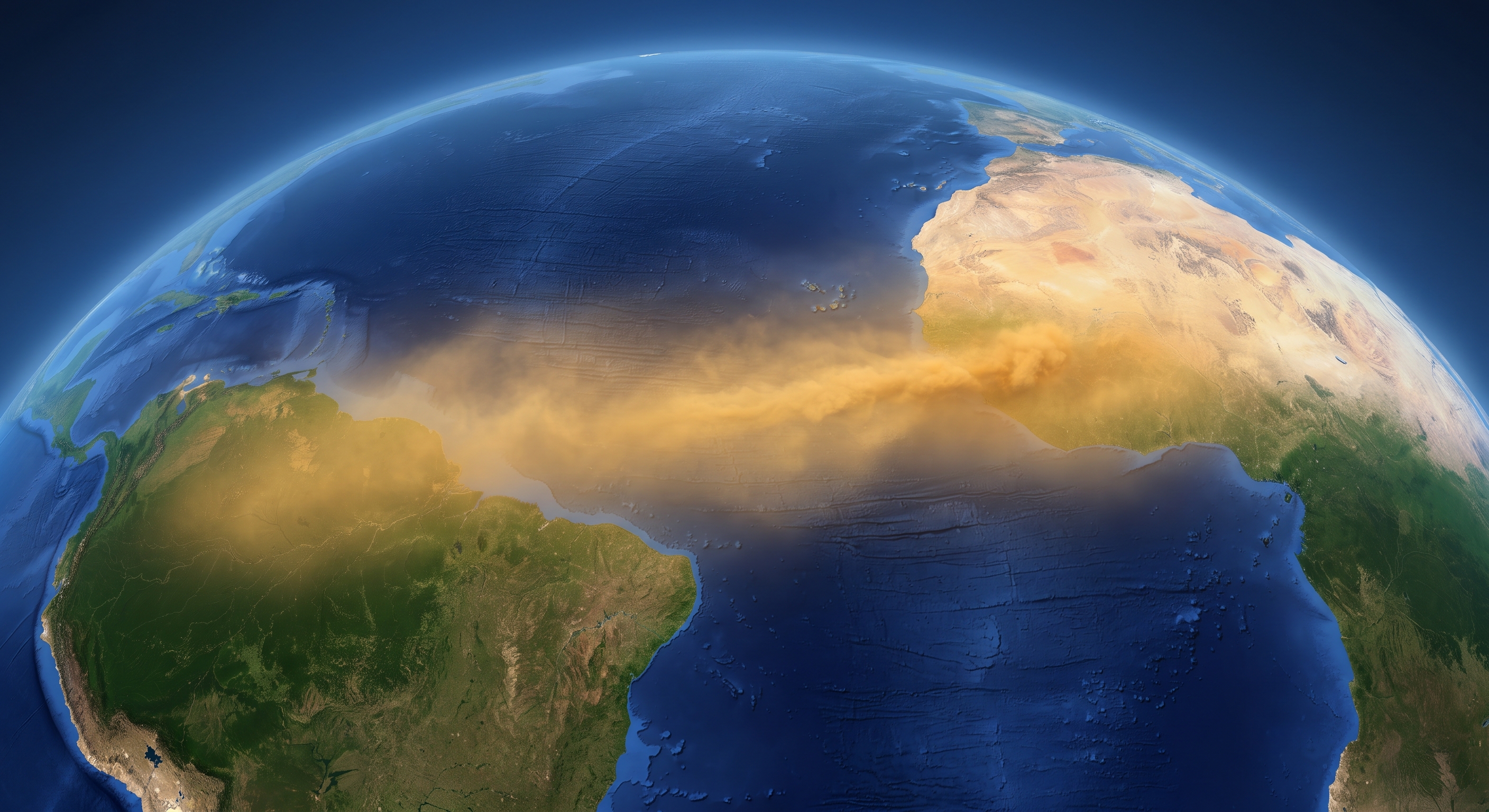
At first glance, the Sahara Desert and the Amazon Rainforest couldn’t be more different. One is a scorching, arid expanse of sand dunes and stone, while the other is a lush, vibrant jungle bursting with biodiversity. Yet, despite being separated by thousands of miles of ocean, these two ecosystems are deeply intertwined in one of Earth’s most astonishing natural cycles.
The Ancient Origin: Inside the Bodélé Basin
The journey begins thousands of miles away from South America, in northern Chad, right within the Bodélé Depression.
- A Prehistoric Mega-Lake: During the African Humid Period thousands of years ago, this region was covered by a massive freshwater body known as Mega-Chad.
- Diatom Deposits: As the lake eventually dried up, it left behind trillions of fossilized microscopic algae shells called diatoms, creating an ultra-fine, mineral-rich dust bowl.
Today, the Bodélé Basin is known as one of the dustiest places on Earth, acting as the primary engine for this continental delivery system.
The 4,000-Mile Transatlantic Journey
Every year, seasonal high-altitude winds sweep across the desert, lifting millions of tons of dust high into the atmosphere.
- The Atlantic Crossing: High-altitude trade winds catch these massive plumes, carrying them roughly 4,000 miles across the Atlantic Ocean.
- The Scale: NASA satellite data estimates that tens of millions of tons of dust complete this incredible cross-continental voyage annually, settling right over the Amazon Basin.
Why the Amazon Needs the Dust
You might wonder why a lush rainforest would need dust from a desert. The answer lies in the chemistry of tropical soils:
- Leached Nutrients: Heavy tropical downpours constantly wash away soluble nutrients from the Amazon’s shallow soil, particularly phosphorus, which is essential for plant growth and photosynthesis.
- The Replenishment: The dust arriving from Africa delivers roughly 22,000 tons of phosphorus annually—almost precisely matching the amount washed away by the region’s rivers.
Without this airborne fertilizer from across the sea, the Amazon’s soil would slowly degrade over centuries, drastically altering the health of the world’s most productive rainforest. It is a stunning reminder of how finely tuned and globally connected our planet truly is.
Bibliography
- Ben-Ami, Y., et al. (2010). Transport of North African dust from the Bodélé depression to the Amazon Basin: a case study. Atmospheric Chemistry and Physics, 10, 7533–7544.
- Koren, I., et al. (2006). The Bodélé depression: A single spot in the Sahara that provides most of the mineral dust to the Amazon forest. Environmental Research Letters.
- NASA Earth Observatory (2007, 2015). Bodele Depression Dust Feeds Amazon / Aerosol Optical Depth Studies. National Aeronautics and Space Administration.
- Yu, H., et al. (2015). The translatlantic transport of Saharan dust and its vibrant role in Amazon basin fertilization. Geophysical Research Letters, NASA Goddard Space Flight Center.

Leave a Reply